
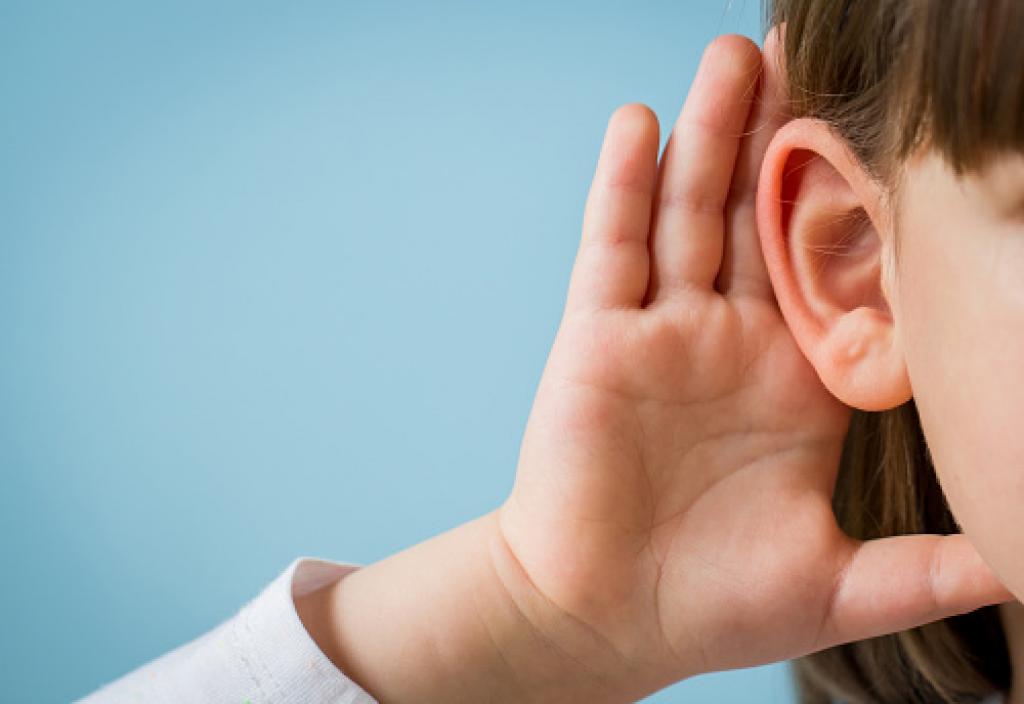
Hearing loss
Hearing loss is defined as diminished acuity to sounds which would otherwise be heard normally. The terms hearing impaired or hard of hearing are usually reserved for people who have relative inability to hear sound in the speech frequencies. The severity of hearing loss is categorized according to the increase in intensity of sound above the usual level required for the listener to detect it.
Deafness is defined as a degree of loss such that a person is unable to understand speech, even in the presence of amplification. In profound deafness, even the highest intensity sounds produced by an audiometer (an instrument used to measure hearing by producing pure tone sounds through a range of frequencies) may not be detected.
There are very rare types of hearing loss that affect speech discrimination alone. One example is auditory neuropathy, a variety of hearing loss in which the outer hair cells of the cochlea are intact and functioning, but sound information is not faithfully transmitted by the auditory nerve to the brain.
Speech perception
Speech perception is another aspect of hearing which involves the perceived clarity of a word rather than the intensity of sound made by the word. In humans, this is usually measured with speech discrimination tests, which measure not only the ability to detect sound, but also the ability to understand speech. There are very rare types of hearing loss that affect speech discrimination alone.
One example is auditory neuropathy, a variety of hearing loss in which the outer hair cells of the cochlea are intact and functioning, but sound information is not faithfully transmitted by the auditory nerve to the brain.[22]
Hearing standards
Human hearing extends in frequency from 20 to 20,000 Hz, and in intensity from 0 dB to 120 dB HL or more. 0 dB does not represent absence of sound, but rather the softest sound an average unimpaired human ear can hear; some people can hear down to −5 or even −10 dB. Sound is generally uncomfortably loud above 90 dB and 115 dB represents the threshold of pain.
The ear does not hear all frequencies equally well: hearing sensitivity peaks around 3,000 Hz.
Signs and symptoms
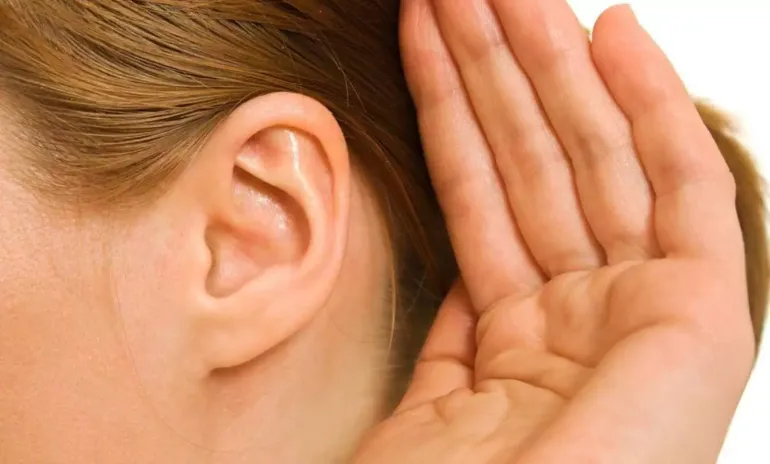
difficulty using the telephone
loss of sound localization
difficulty understanding speech, especially of children and women whose voices are of a higher frequency.
difficulty understanding speech in the presence of background noise (cocktail party effect)
sounds or speech sounding dull, muffled or attenuated
need for increased volume on television, radio, music and other audio sources
pain or pressure in the ears
a blocked feeling
Complications
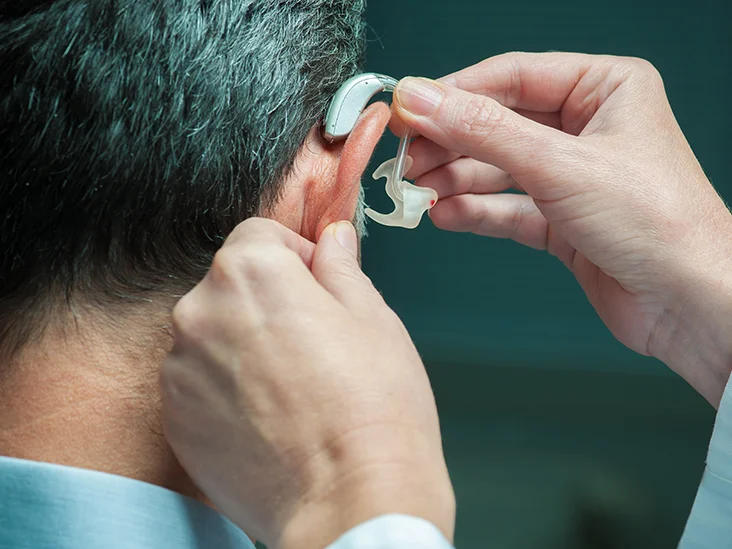
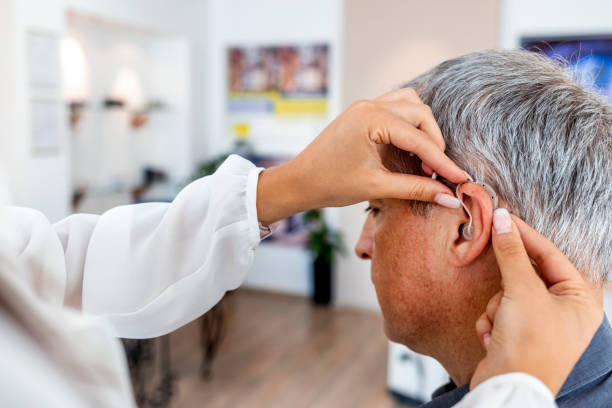
Hearing loss is associated with Alzheimer's disease and dementia.The risk increases with the hearing loss degree. There are several hypotheses including cognitive resources being redistributed to hearing and social isolation from hearing loss having a negative effect. According to preliminary data, hearing aid usage can slow down the decline in cognitive functions.
Hearing loss is responsible for causing thalamocortical dysrthymia in the brain which is a cause for several neurological disorders including tinnitus and visual snow syndrome.
Hearing loss is an increasing concern especially in aging populations. The prevalence of hearing loss increases about two-fold for each decade increase in age after age 40.[30] While the secular trend might decrease individual level risk of developing hearing loss, the prevalence of hearing loss is expected to rise due to the aging population in the US.
Cognitive decline
Hearing loss is an increasing concern especially in aging populations. The prevalence of hearing loss increases about two-fold for each decade increase in age after age 40. While the secular trend might decrease individual level risk of developing hearing loss, the prevalence of hearing loss is expected to rise due to the aging population in the US.
Despite the variability in study design and protocols, the majority of these studies have found consistent association between age-related .
There are very rare types of hearing loss that affect speech discrimination alone. One example is auditory neuropathy, a variety of hearing loss in which the outer hair cells of the cochlea are intact and functioning, but sound information is not faithfully transmitted by the auditory nerve to the brain.
Use of the terms "hearing impaired", "deaf-mute", or "deaf and dumb" to describe deaf and hard of hearing people is discouraged by many in the deaf community as well as advocacy organizations, as they are offensive to many deaf and hard of hearing people.
Falls
The association between age-related hearing loss and Alzheimer's disease was found to be nonsignificant, and this finding supports the hypothesis that hearing loss is associated with dementia independent of Alzheimer pathology. There are several hypothesis about the underlying causal mechanism for age-related hearing loss and cognitive decline.
One hypothesis is that this association can be explained by common etiology or shared neurobiological pathology with decline in other physiological system.Another possible cognitive mechanism emphasize on individual's cognitive load.
The underlying causal link between the association of hearing loss and falls is yet to be elucidated. There are several hypotheses that indicate that there may be a common process between decline in auditory system and increase in incident falls, driven by physiological, cognitive, and behavioral factors. This evidence suggests that treating hearing loss has potential to increase health-related quality of life in older adults.